

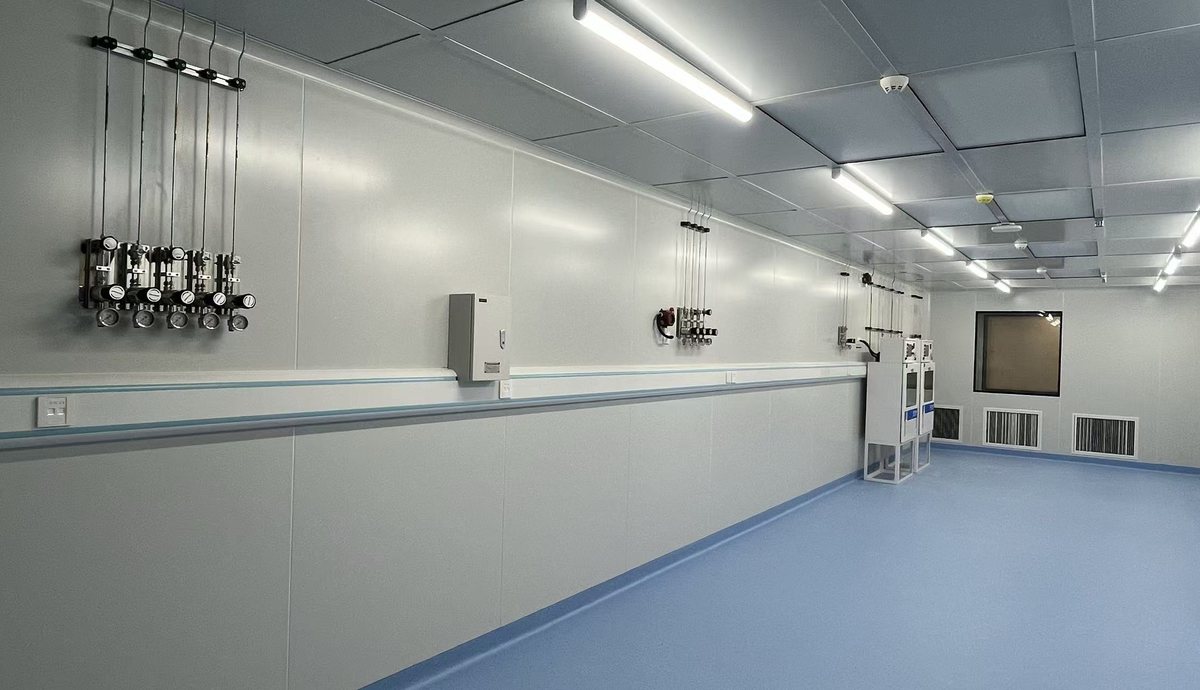
Summary: Every laboratory gas system follows the same six-stage path from source to instrument, but the priorities change with the application. An analytical laboratory needs stable, contamination-free carrier and calibration gases with continuous supply; research laboratory gas supply must stay flexible for many groups and gases that are not known at design time; a research cleanroom needs ultra high purity process gases and full containment of toxic and pyrophoric gases.
This guide compares the three most common laboratory types, works through a typical gas system for each, and lists the questions that should be settled during the programming phase of any laboratory project, so that the gas system is designed for how the building will actually be used.
- Why the application changes the gas system
- Analytical, research and cleanroom labs compared
- Worked example: analytical laboratory
- Worked example: multi-group research building
- Worked example: research cleanroom
- Other laboratory types
- Buildings with several laboratory types
- Budget and programme
- Who operates the system
- Questions for the programming phase
- Common mistakes
- FAQ
Why does the application change the laboratory gas system?
The application changes the laboratory gas system because each type of laboratory has a different answer to four questions: which gases are used, how pure they must be at the instrument, what an interruption costs, and how hazardous the gases are. The equipment families are the same everywhere, from gas cabinets and changeover manifolds to regulators, valves and tubing, but the combination, the purity class and the safety measures differ.
A design that is right for one laboratory type can be wrong for another. A cleanroom specification applied to a teaching laboratory wastes budget on ultra high purity construction that nobody needs, while an analytical laboratory designed like a general research floor may suffer drifting baselines because carrier gases share regulators or run through unsuitable tubing. The applications overview describes the main sectors; this guide shows how the differences translate into design decisions.
How do analytical, research and cleanroom laboratories compare?
Analytical, research and cleanroom laboratories differ most in purity class, hazard level and how predictable their gas lists are. The comparison below summarises the typical answers for each type.
| Factor | Analytical laboratory | Multi-group research building | Research cleanroom |
|---|---|---|---|
| Typical gases | Helium, hydrogen, nitrogen, argon, zero air, calibration mixtures | Nitrogen, argon, helium, oxygen, CO2, air, mixtures, liquid nitrogen | Process gases such as silane, ammonia, chlorine, hydrogen bromide, plus UHP nitrogen, argon, hydrogen |
| Purity class | High purity | Laboratory to high purity, some UHP | Ultra high purity |
| Cost of interruption | High: failed sequences, recalibration | Variable: long experiments are critical, others are not | Very high: tool downtime, scrapped wafers or samples |
| Main hazards | Hydrogen, high-pressure cylinders | Asphyxiation from inert and cryogenic gases, mixed hazards | Toxic, pyrophoric, corrosive and flammable gases |
| Gas list at design stage | Known and stable | Partly unknown, changes with research groups | Known per tool, grows as tools are added |
| Typical source | Central manifolds, generators for N2, H2 and zero air | Central gas room, bulk nitrogen, local specialty cylinders | Gas cabinets, VMBs, bulk specialty gas systems |
| Changeover | Automatic for carrier gases | Automatic for shared critical gases, manual for others | Automatic cabinets with purge sequences |
| Key design focus | Stable pressure, clean last metre, traceable calibration gases | Flexibility, spare capacity, clear labelling | Containment, detection, UHP construction and qualification |
What does a typical analytical laboratory gas system look like?
An analytical laboratory gas system supplies carrier, fuel, makeup and calibration gases to instruments such as gas chromatographs, GC-MS, LC-MS, ICP-OES and ICP-MS, and its main goal is a stable, contamination-free supply that never stops in the middle of a sequence. A typical environmental, food, pharmaceutical QC or contract testing laboratory has between ten and fifty instruments sharing a short list of gases.
- Helium or hydrogen carrier gas: supplied from a central manifold with automatic changeover, or hydrogen from a generator, with a point-of-use regulator at every instrument.
- Nitrogen: often the largest consumer, because LC-MS nebuliser and drying gas flows are high; an on-site nitrogen generator or a liquid supply usually costs less than cylinders.
- Argon for ICP: an ICP plasma typically uses well over 10 litres of argon per minute while running, so liquid argon dewars or bulk supply with automatic changeover are common.
- Zero air and fuel gases: zero air generators or high purity cylinders for detectors, and hydrogen for flame ionisation detectors.
- Calibration mixtures: kept local to the analysers that use them, with short stainless steel lines and regulators suited to reactive components, and cylinder certificates recorded for traceability.
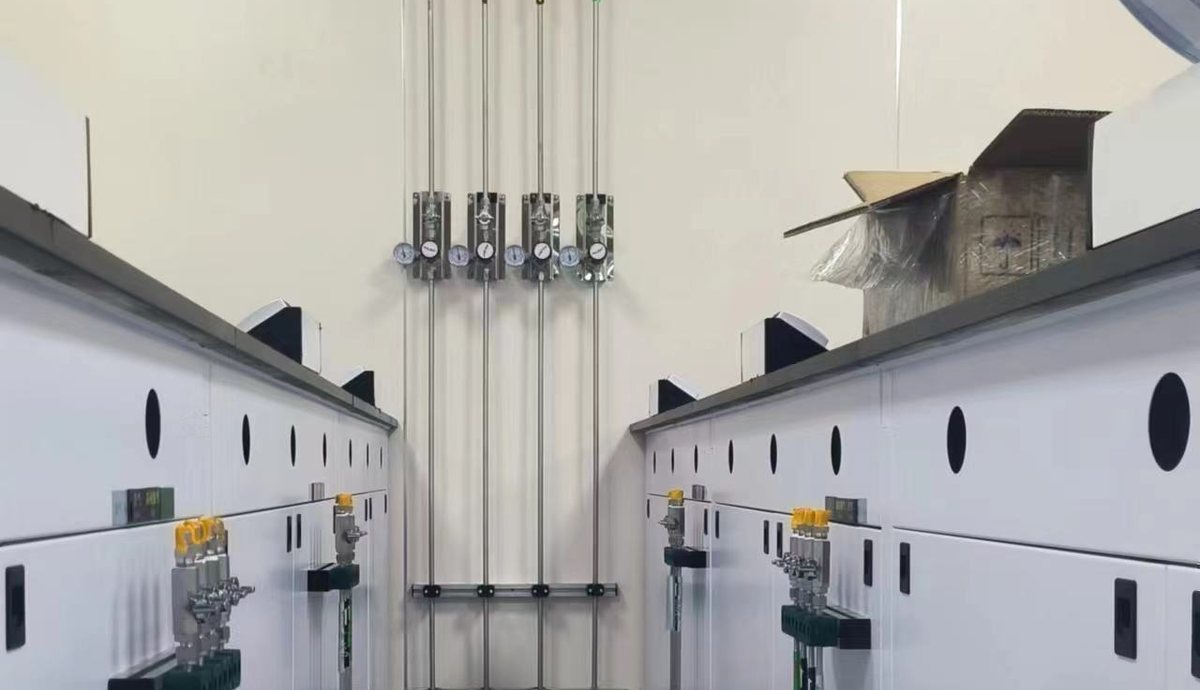
The last metre to the instrument decides the quality of an analytical laboratory gas system. Shared regulators, polymer tubing at the instrument, leaking joints and poor purging after cylinder changes cause baseline drift and ghost peaks that are often blamed on the instrument. Each instrument should have its own final regulator and isolation valve, connections should be stainless steel with compression fittings, and cylinder changes should follow a purge routine.
Hydrogen safety is the main hazard question in analytical laboratories, especially where hydrogen replaces helium as carrier gas. Hydrogen lines should have flow limitation, hydrogen detection where gas could accumulate, and automatic shut-off on detection, and hydrogen generators should be sized for actual demand rather than oversized. Laboratories accredited to ISO/IEC 17025 also need traceable records for calibration gas cylinders. The environmental testing laboratories page covers calibration gas handling in more depth.
What does a typical research building gas system look like?
Research laboratory gas supply for a multi-group building must serve many research groups whose needs change every few years, so the defining requirement is flexibility rather than one optimised configuration. A typical university science building or research institute floor has chemistry, biology, physics and materials groups sharing common gases, with a few groups using special gases of their own.
- Common gases from a central gas room: nitrogen, argon, helium, compressed air, CO2 for incubators and oxygen are piped to every laboratory through a central gas supply system.
- High-volume nitrogen from bulk: a bulk liquid nitrogen tank with vaporisers often supplies nitrogen gas, and the same tank can feed liquid nitrogen to dewar filling stations or directly to laboratories.
- Special gases locally: gases used by one group, such as a calibration mixture or a small quantity of a toxic gas, are supplied from a local cylinder or a small gas cabinet in or near that laboratory.
- Spare capacity: capped branches in every laboratory and spare manifold positions in the gas room, because new groups bring new gases.
- Clear labelling and isolation: every outlet, line and valve labelled, with isolation per laboratory, so that groups can change their set-up without affecting neighbours.
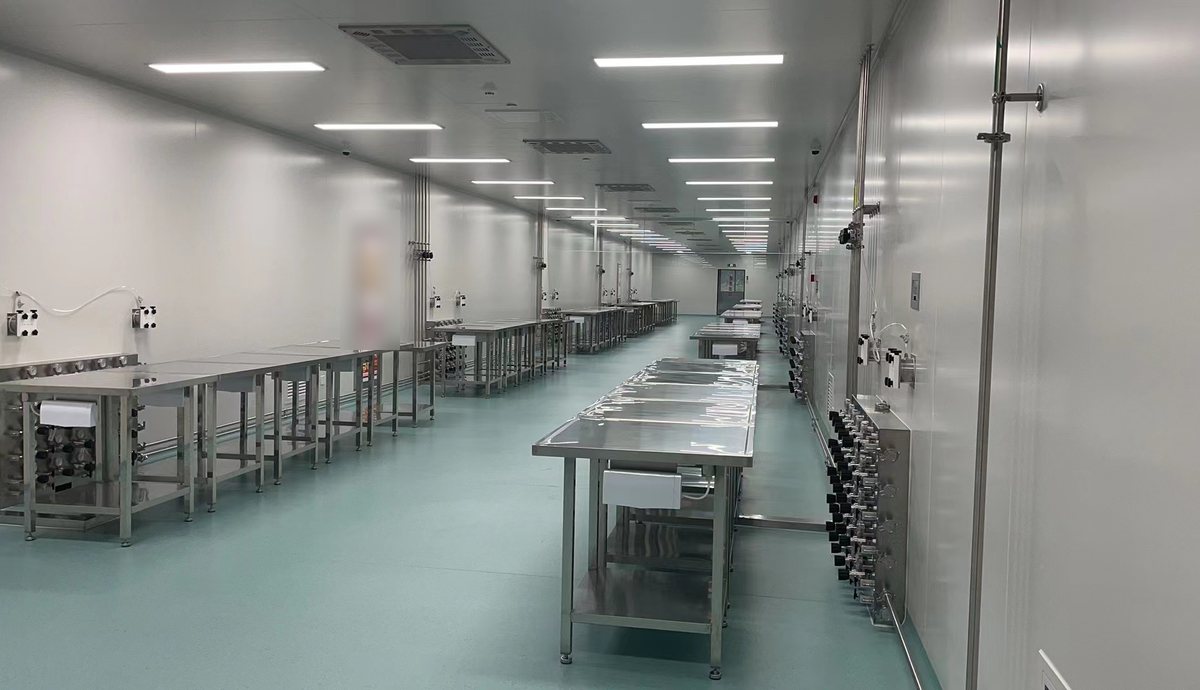
Asphyxiation is the most common serious gas hazard in research buildings. Nitrogen, argon, helium and especially liquid nitrogen can displace oxygen in small rooms, cold rooms and basement laboratories without any warning smell, so oxygen depletion monitors with alarms are needed wherever inert gases or cryogenic liquids are used in quantity.
Research buildings also raise organisational questions that affect the design. Gas metering by floor or group may be needed if gas costs are recharged to research groups, teaching laboratories need simple and robust outlets, and an older building may need its gas system brought up to current practice in phases. The universities and research institutes page describes these situations, and our campus liquid nitrogen project shows one example.
What does a typical research cleanroom gas system look like?
A research cleanroom gas system supplies ultra high purity process gases to tools such as etchers, deposition systems, furnaces and MOCVD reactors, and its two defining requirements are containment of hazardous gases and purity at parts-per-billion levels. Typical examples are university nanofabrication facilities, compound semiconductor laboratories, photovoltaic and display pilot lines and industrial R&D cleanrooms.
- Hazardous gases in gas cabinets: toxic, pyrophoric and corrosive gases are supplied from exhausted, automatic gas cabinets with purge, detection and shut-off, usually in a dedicated gas room or sub-fab.
- Valve manifold boxes: each gas that serves several tools passes through a VMB with one stick per tool and spare sticks for future tools.
- UHP construction: electropolished 316L tubing, orbital welds, metal diaphragm valves and point-of-use filtration, qualified by helium leak, moisture, oxygen and particle tests.
- Dedicated purge and vent: purge nitrogen for hazardous panels from a dedicated source, and vents and exhaust connected to abatement where required.
- Integrated detection: gas detection at cabinets, VMBs and tool connections, linked to automatic shut-off and to the facility alarm system.
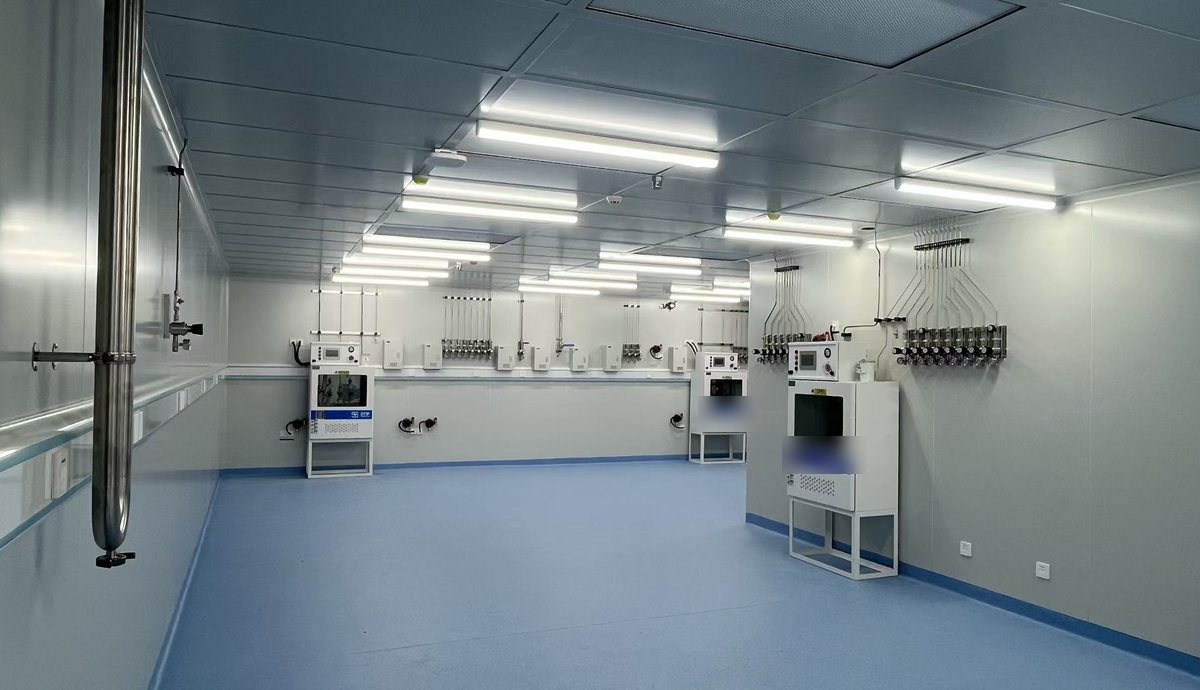
The difference between a research cleanroom and a production fab is mainly change and scale. Research cleanrooms add, move and modify tools more often, so spare VMB sticks, spare cabinet positions and accessible routes matter more than in production, while production fabs need higher flows, more redundancy and often bulk specialty gas systems. The gas cabinets, VMB and BSGS guide and the UHP gas delivery system guide cover the equipment and qualification, and the micro-nano fabrication project shows a shared platform in practice.
How do other laboratory types differ?
Other laboratory types use the same building blocks with their own priorities, and the main differences are summarised below.
| Laboratory type | Main gas priorities |
|---|---|
| Pharmaceutical and biotech | Documented, continuous supply for QC instruments, CO2 for incubators, nitrogen and process gases for bioprocess, records structured for qualification; see pharma and biotech |
| Medical and diagnostic | Continuity for laboratories that never close, alarms that reach staff at all hours, simple operation; see medical and diagnostic |
| Chemical and petrochemical | Many gases and hazard classes in one building, segregation, reactive gas handling; see chemical laboratories |
| Environmental testing | Calibration gas integrity, traceability, zero air and nitrogen demand |
| Battery and materials | High-purity argon for glove boxes, dry gas, furnace atmospheres with hydrogen mixtures |
How should a building with several laboratory types be zoned?
A building that contains several laboratory types should be zoned by purity class and hazard rather than by department, so that each zone is built to the specification it needs. A common pattern is a central gas room for laboratory-grade and high purity common gases serving the whole building, a specialty gas room or sub-fab for the cleanroom's hazardous and UHP gases, and local supply for single-instrument gases.
Zoning lets the expensive measures stay where they are needed. UHP construction and helium leak qualification apply to the cleanroom zone, high purity stainless steel construction applies to analytical zones, and laboratory-grade components serve general research and utility gases. Each zone should have its own isolation, so that work in one zone does not interrupt another.
Shared gases between zones need care. Nitrogen from one bulk tank can feed both general laboratories and a cleanroom, but the cleanroom branch should have its own purification or filtration, isolation and monitoring, so that a disturbance in the general network does not reach UHP tools.
How do budget and programme differ by laboratory type?
The budget of a laboratory gas system depends more on purity class and hazard than on floor area, so two buildings of the same size can need very different investments. The table shows where the money and the time usually go for each laboratory type.
| Laboratory type | Main cost drivers | Main programme drivers |
|---|---|---|
| Analytical laboratory | Number of instruments and outlets, automatic changeover, generators, stainless steel last-metre connections | Instrument delivery dates and validation of each instrument on the new supply |
| Multi-group research building | Number of gases and outlets, central gas room, bulk nitrogen, spare capacity, oxygen depletion monitoring | Building construction sequence, and user consultation across many groups |
| Research cleanroom | Gas cabinets, VMBs, UHP welded lines, detection and abatement, qualification testing | Factory build and test of cabinets and VMBs, and UHP qualification before tool hook-up |
Programme risk is highest where equipment is built to order. Gas cabinets, VMBs and pressure control panels are assembled and tested in a workshop before delivery, so ordering them early, while the building is still under construction, keeps the gas system off the critical path. Analytical laboratories gain most from phased connection, in which each instrument is moved to the new supply only after its branch is tested and purged.
Who operates the gas system in each laboratory type?
The people who operate a laboratory gas system after handover differ by laboratory type, and the design and training should match them. In an analytical laboratory, technicians usually change cylinders and check pressures, so changeover status, low-pressure alarms and simple purge routines at the panel matter most. In a research building, facility staff manage the central gas room while many users touch only outlets, so clear labels, isolation per laboratory and a single contact for gas changes prevent confusion.
In a research cleanroom, a dedicated facility team runs gas cabinets, VMBs and detection, often around the clock, so automatic purge sequences, remote status monitoring and documented procedures for cylinder changes and line modifications are essential. Whatever the laboratory type, training should be given on the installed equipment to the people who change cylinders and answer alarms, and written procedures should remain beside the gas room and panels.
Which questions should be settled in the programming phase?
The programming phase is the stage of a laboratory project in which the building's uses are defined, and gas requirements decided then cost far less than changes made after the layout is fixed. The questions below should be answered for every laboratory and every gas before detailed design starts.
- Which laboratory types and research groups will the building house, now and in five years?
- Which gases will each laboratory use, at what grade, and which are not yet known?
- What are the normal and peak flows and the inlet pressure of each instrument?
- Which gases are critical, and what does an interruption cost each user?
- Which gases are toxic, pyrophoric, corrosive, flammable or oxidising, and in what quantities?
- Where can the gas room, specialty gas room and bulk tanks go, with delivery access?
- Which spaces need oxygen depletion or toxic gas monitoring?
- How will alarms be routed outside working hours?
- Will gas use be metered or recharged to groups?
- What documentation and testing does the client's quality system require?
A structured gas audit answers these questions with the users. The lab gas system design guide lists the information to collect, and the laboratory gas delivery system guide explains how the answers become a design.
What are the most common mistakes across laboratory types?
- One specification for the whole building. Zone by purity class and hazard instead.
- Designing a research building for today's groups only. Spare capacity and flexible outlets keep the system useful as groups change.
- Shared regulators in analytical laboratories. Every instrument needs its own final regulation.
- No oxygen depletion monitoring. Inert gases and liquid nitrogen are the most common gas hazard in research buildings.
- No spare sticks or cabinet positions in cleanrooms. Tools are added more often than planned.
- Gas requirements collected after the layout is fixed. Gas rooms, risers and routes should be placed during programming.
Frequently asked questions
What gases does a research laboratory usually need?
A research laboratory usually needs nitrogen, argon, helium, compressed air, carbon dioxide and oxygen, plus liquid nitrogen and a few specialty gases or mixtures for particular groups. The exact list depends on the research disciplines and changes over time, so research buildings need spare capacity.
What is different about an analytical laboratory gas system?
An analytical laboratory gas system is built around stable, contamination-free carrier, fuel and calibration gases for instruments such as GC, GC-MS, LC-MS and ICP. It needs automatic changeover for carrier gases, a separate final regulator for each instrument and clean stainless steel connections in the last metre.
Does a cleanroom laboratory need ultra high purity gas lines?
A cleanroom laboratory needs ultra high purity gas lines for process gases that reach semiconductor, compound semiconductor and thin film tools. Utility gases in the same building, such as compressed air or general nitrogen for equipment, can often use high purity or laboratory-grade construction.
Should research laboratories use gas generators?
Research laboratories can use nitrogen, hydrogen or zero air generators where demand is steady and close to the instruments, such as LC-MS nitrogen or GC hydrogen. Generators need power, maintenance and a backup source, so they are compared with cylinders and bulk supply using actual consumption.
How is oxygen depletion prevented in laboratories?
Oxygen depletion is prevented by limiting the quantity of inert gases and cryogenic liquids in small rooms, providing ventilation, and installing oxygen depletion monitors with local and remote alarms wherever nitrogen, argon, helium or liquid nitrogen could displace air.
Can one gas room serve laboratories with different purity needs?
One gas room can serve laboratories with different purity needs if each gas line is built to the purity class of its most demanding user, or if separate lines are run for different classes. Cleanroom branches of shared gases usually add their own filtration, isolation and monitoring.
Plan the gas system for your laboratory type with LGS
LGS designs, builds and installs laboratory gas systems for analytical and QC laboratories, multi-group research buildings, research cleanrooms and production laboratories, from central gas rooms and generators to gas cabinets, VMBs and UHP lines. Send your laboratory types, gas list and floor plans to info@labgassystem.com, and our engineers will propose a zoning, source and distribution concept for your building.
Explore more on the LGS website: applications by industry, research laboratories, semiconductor and cleanrooms, laboratory gas system types and installed projects, or contact our engineering team.