

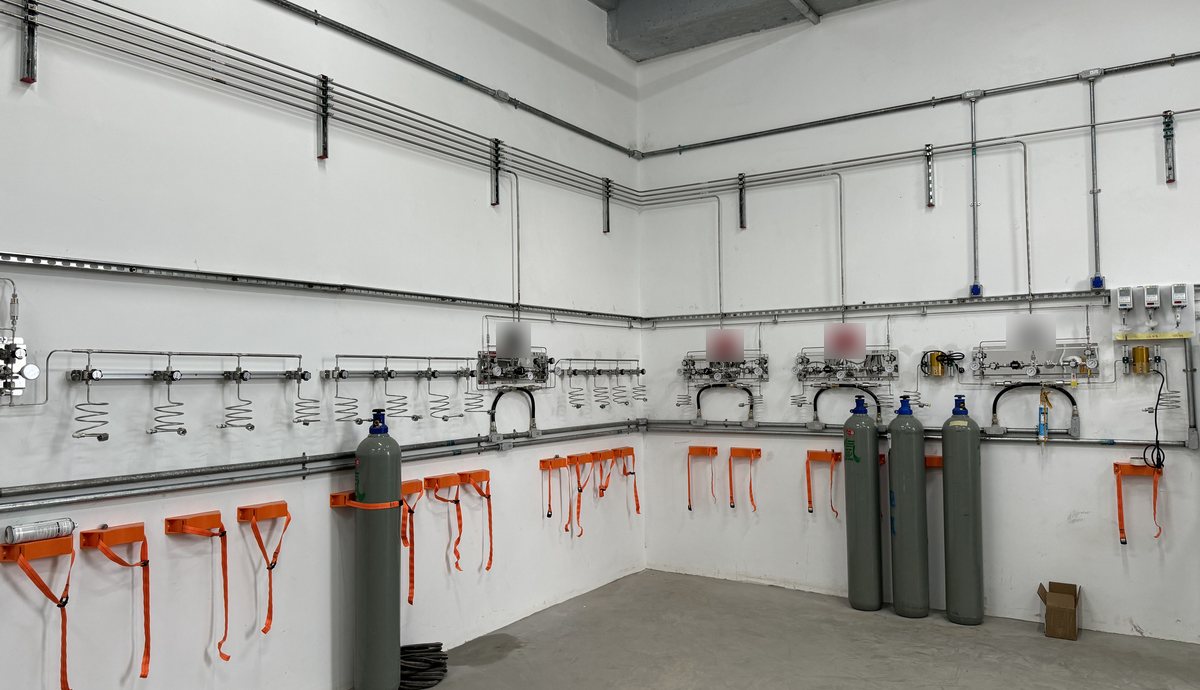
Summary: A central laboratory gas supply system moves gas cylinders out of the laboratories into one ventilated, monitored gas room, where changeover manifolds feed fixed pipelines to outlets in every laboratory. A central laboratory gas supply system pays off when several laboratories use the same gases, when gases must never run out, or when cylinder handling in corridors and benches has become a safety or labour problem.
Planning a central laboratory gas supply system means deciding which gases to centralise, building a business case, giving the gas room the space and safety functions it needs, sizing cylinder banks for weekends and holidays, choosing changeover and monitoring per gas, and phasing the conversion so laboratories keep working. This guide covers each of those decisions and what to put in the tender.
- What a central laboratory gas supply system is
- When centralising pays off
- Building the business case
- What the gas room needs
- Sizing cylinder banks: a worked example
- Changeover and monitoring by gas
- Bulk tanks, generators and hazardous gases
- Converting a working building
- Scope, interfaces and the tender
- Common mistakes
- FAQ
What is a central laboratory gas supply system?
A central laboratory gas supply system, also called a centralized gas supply system for laboratories, is an arrangement in which every gas source for a building or floor sits in one dedicated gas room instead of beside the instruments. Cylinders, cylinder bundles or the connection to a bulk tank are mounted on changeover manifolds in the gas room, a first stage of pressure regulation sets a distribution pressure, and stainless steel pipelines carry each gas to point-of-use panels in the laboratories, where a final regulator sets the pressure each instrument needs.
A central laboratory gas supply system has three zones with different owners and different rules. The gas room is the supply zone, where cylinders are delivered, connected and changed by trained staff. The risers and ceiling routes are the distribution zone, where lines are supported, labelled and isolated by floor and by room. The laboratories are the use zone, where users see only outlets, regulators and gauges. The layout of each zone is described on our central laboratory gas supply system page; this guide concentrates on the decisions that decide whether a project succeeds.
When does a central laboratory gas supply system pay off?
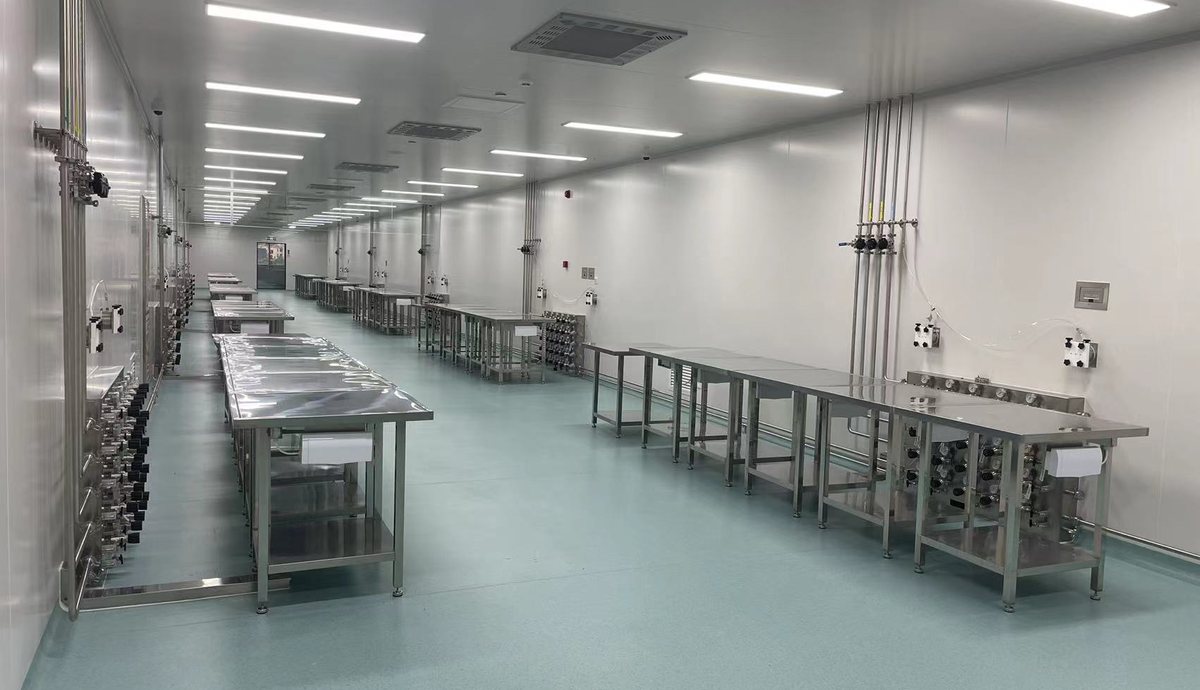
A central laboratory gas supply system pays off when the same gases are used in several rooms and the supply must be continuous. A single laboratory with one gas chromatograph rarely needs a gas room; a research floor with ten laboratories using nitrogen, argon, helium and synthetic air almost always does. The table below summarises the signals that point towards central supply and the signals that point towards keeping local cylinders.
| Signal | Points towards central supply | Points towards local supply |
|---|---|---|
| Users per gas | The same gas is used in three or more rooms | One instrument uses the gas |
| Criticality | An interruption stops long runs, cultures or production | Runs can be paused and restarted easily |
| Consumption | Cylinders are changed weekly or more often | A cylinder lasts months |
| Cylinder handling | Cylinders travel through corridors, lifts and occupied labs | One cylinder is changed rarely, close to a door |
| Hazard | Flammable or toxic gases are spread across many rooms | A small quantity of a hazardous gas is used in one fume cupboard |
| Building stage | New building or major refurbishment with riser space available | Short-term lease or temporary laboratory |
Most buildings end up with a mix: a central laboratory gas supply system for the gases used widely, point-of-use cylinders or generators for single-instrument gases, and exhausted gas cabinets for hazardous specialty gases. The decision is made gas by gas, not for the building as a whole.
How do you build the business case for central gas supply?
The business case for a central laboratory gas supply system compares the yearly cost of the current cylinder arrangement with the yearly cost of central supply, plus the installation cost. Laboratory and facility managers usually find that the largest savings are not the price of gas but the hidden costs around cylinders: rental, handling time, gas returned unused and interrupted work.
| Cost item | With cylinders in each laboratory | With a central gas room |
|---|---|---|
| Cylinder rental | One duty cylinder per gas per laboratory, often plus a spare | Duty and reserve banks shared by all laboratories |
| Handling labour | Staff fetch, move and connect cylinders across the building | Deliveries and changes happen in one room by trained staff |
| Residual gas returned | Cylinders are often changed early to avoid running out | Automatic changeover lets each cylinder be used almost fully |
| Interrupted work | A cylinder running out stops a run, sometimes overnight | The reserve bank takes over and an alarm reports the empty side |
| Regulators and leak points | A cylinder regulator and connection in every laboratory | Fewer high-pressure connections, all in one monitored room |
| Space and safety | Cylinders occupy laboratory floor space and need restraints and signage in every room | Laboratory space is freed and high-pressure hazards are concentrated in one controlled room |
A simple way to quantify the business case is to count, for one year, the number of cylinder changes, the time each change takes including transport, the rental days for every cylinder on site, and the number of runs lost to an empty cylinder. Multiplying each count by the site's own labour rate, rental rate and cost of a lost run gives a baseline that central supply can be compared with. Using site figures rather than generic percentages makes the business case credible to management and finance.
The installation cost of a central laboratory gas supply system depends on the number of gases, the distance from the gas room to the laboratories, the purity class and the changeover level. A supplier can only price it reliably after a survey, which is why a gas audit and a site visit should come before any budget figure.
What does a central gas room need?
A central gas room needs enough space, safe access and safety functions for the gases it holds, and the gas room is the part of a central laboratory gas supply system that is hardest to change after construction. A gas room drawn into left-over space is usually too small, too far from the laboratories or impossible to reach with a cylinder trolley.
- Location and access: ground floor or a level with a goods lift, on an external wall where possible, with a level route for cylinder trolleys from the delivery point.
- Space: room for full and empty cylinders of every gas, both sides of every manifold, safe working space in front of each manifold, and space for future gases.
- Ventilation: mechanical or natural ventilation sized for the gases stored, with exhaust positioned for gases lighter or heavier than air.
- Segregation: flammable gases separated from oxidising gases by distance or fire-rated barriers, and toxic gases in exhausted gas cabinets.
- Detection and alarms: oxygen depletion monitoring for inert gases, flammable and toxic gas detection where relevant, and alarms repeated outside the room and to the building management system.
- Emergency shut-off: clearly marked isolation for each gas at the room exit and, for hazardous gases, automatic shut-off on detection.
- Cylinder restraint and signage: chains or straps for every cylinder position, gas identification at every manifold and line, and posted emergency instructions.
Local codes set the detailed requirements for a gas room. In the United States, NFPA 55 covers the storage and use of compressed gases and cryogenic fluids and NFPA 45 covers laboratories using chemicals; other countries have equivalent fire and building codes. The design should state which code is followed and should be reviewed with the building's safety officer before construction.
How many cylinders does each bank need?
Each cylinder bank in a central laboratory gas supply system should hold enough gas to cover the longest period without a cylinder change, usually a weekend or a public holiday, with a safety margin. The duty side supplies the laboratories, the reserve side takes over automatically when the duty side is empty, and the empty side must be replaced before the reserve runs out.
A worked example shows the method. Assume a research floor uses nitrogen at an average of 2 cubic metres per working day and up to 3 cubic metres on peak days, and that no cylinder change is possible from Friday afternoon to Tuesday morning after a long weekend, which is four days. A 50 litre cylinder filled to 200 bar holds roughly 9 to 10 cubic metres of nitrogen at atmospheric pressure. Four peak days need about 12 cubic metres, so each side of the manifold should hold at least two cylinders, and a third cylinder per side gives margin for a missed delivery. A two-by-three manifold therefore suits this example, while a gas used at 0.2 cubic metres per day could run for weeks on a single cylinder per side.
Cylinder bank sizing should be repeated for every gas, using the gas supplier's actual cylinder sizes and fill pressures, the measured or estimated consumption from the gas audit, and the site's real delivery schedule. When the calculation shows more than about six cylinders per side, a cylinder bundle or a bulk liquid supply is usually more practical than a larger manifold.
Which changeover method and monitoring does each gas need?
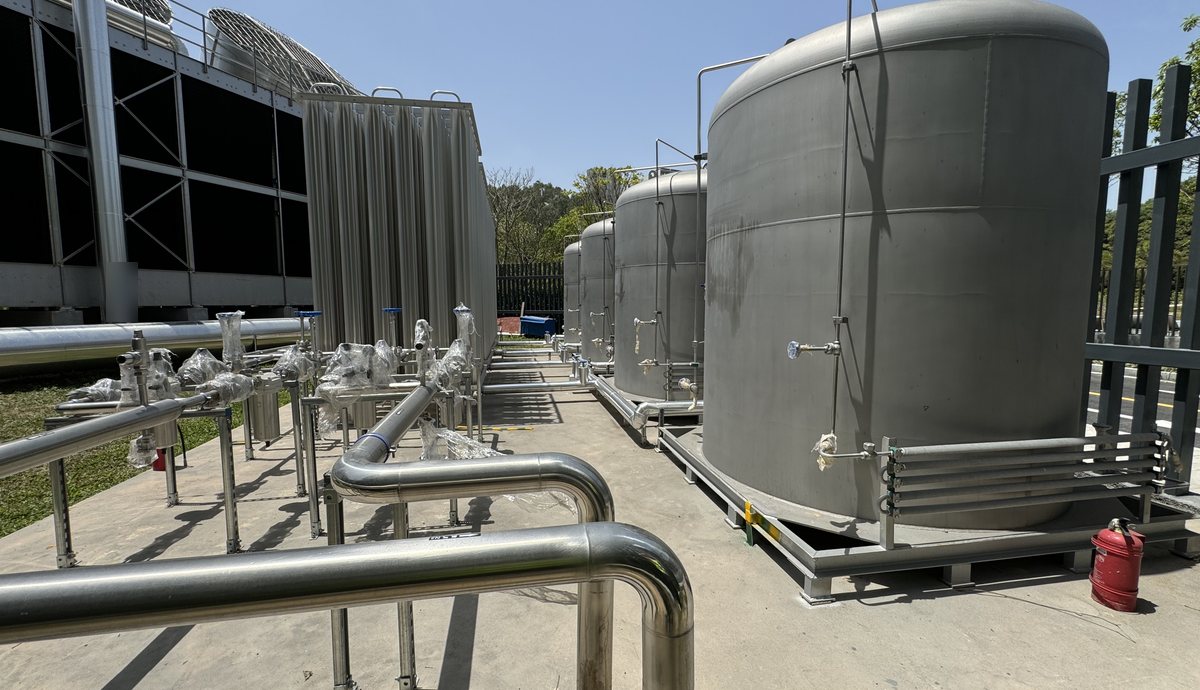
The changeover method in a central laboratory gas supply system should be chosen gas by gas according to how critical the gas is and how often its cylinders are changed. A manual changeover manifold needs an operator to switch sides and suits gases that can tolerate a short interruption. A semi-automatic manifold switches automatically and is reset after the empty cylinders are replaced. A fully automatic manifold switches, alarms and reports its status without intervention, and suits critical gases and gas rooms that are not staffed every day. The gas changeover manifold range covers all three types.
Monitoring is what turns a central laboratory gas supply system into a reliable one. Each critical gas should report at least three states: duty side in use, reserve side in use, and low line pressure. Those signals should reach a panel outside the gas room and the building management system, and alarm routing should name the person who responds outside working hours. A fully automatic switchover manifold with remote status outputs makes this straightforward.
Pressure stability at the instrument depends on staged regulation rather than on the manifold alone. The manifold regulator sets a distribution pressure, and a point-of-use regulator in each laboratory sets the final pressure. Two-stage regulation prevents the small pressure step that occurs when a manifold switches from the duty side to the reserve side from reaching sensitive instruments such as gas chromatographs.
Where do bulk tanks, generators and hazardous gases fit?
Bulk liquid tanks and on-site generators are part of a central laboratory gas supply system, not alternatives to it. A bulk liquid tank with vaporisers suits nitrogen, argon or oxygen used in large, continuous volumes, and connects to the same distribution network as the cylinder manifolds, with a cylinder bank kept as automatic backup for deliveries and maintenance. An on-site nitrogen or hydrogen generator can feed the central network or a single laboratory, but it needs power, servicing and a backup source.
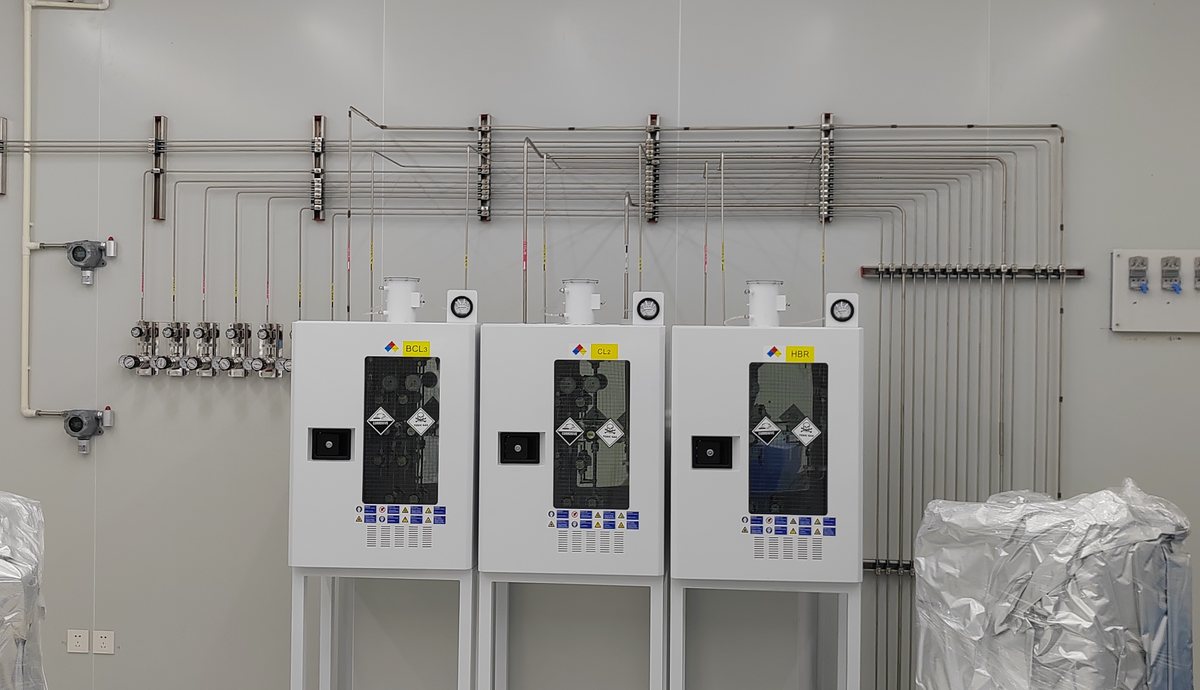
Hazardous specialty gases are usually kept out of the general gas room. Toxic, pyrophoric and corrosive gases such as silane, ammonia, chlorine or hydrogen bromide are supplied from exhausted gas cabinets with purge panels, gas detection and automatic shut-off, often in a separate specialty gas room, and are distributed to tools through valve manifold boxes. Flammable gases such as hydrogen need their own detection and ventilation measures wherever they are stored.
How do you convert a working building to central gas supply?
A working building can be converted to a central laboratory gas supply system without stopping research, provided the conversion is phased by floor or by laboratory. The conversion sequence below keeps every laboratory supplied throughout.
- Survey every user. Record every cylinder, gas, grade, instrument, flow and pressure in every laboratory, and mark where cylinders are stored today.
- Build and commission the gas room first. Install manifolds, alarms and the first section of main line while laboratories continue on their local cylinders.
- Install risers and main routes. Run lines in corridors and risers outside working hours where needed, capped and pressurised with inert gas until connected.
- Connect laboratories one at a time. For each laboratory, fit the point-of-use panels, test and purge the branch, switch instruments to piped gas, and only then remove the local cylinders.
- Prove and hand over each phase. Leak test, purge and cross-connection check every branch, and update drawings and labels before the next laboratory starts.
Shutdowns during a conversion should be short, announced in advance and scheduled outside critical periods. Every connection to a live line should be isolated, purged and leak checked before the line reopens, and nearby instruments should be protected from dust. Our installation page describes how LGS phases work in laboratories that cannot stop.
How should the scope and tender be defined?
The scope of a central laboratory gas supply system crosses several trades, and most problems start at the interfaces between them. A tender should state who provides each interface, so that nothing is priced twice or left out.
| Interface | Typical owner | What the gas specialist needs |
|---|---|---|
| Gas room construction, fire rating, doors | Building contractor | Room dimensions, door widths, wall build-up for manifold fixing |
| Ventilation and exhaust | HVAC contractor | Air change rate, exhaust connections for gas cabinets |
| Power and alarm wiring | Electrical contractor | Supplies to manifolds, detectors and shut-off valves; BMS interface |
| Riser and ceiling space | Architect and MEP engineer | Reserved routes, access panels and fire-stopping details |
| Gas supply contract | Owner and gas supplier | Cylinder sizes, connections, bulk tank boundary and delivery schedule |
| Manifolds, lines, panels, testing | Gas system specialist | Gas list, outlet positions, purity class, documentation requirements |
A request for quotation for a central laboratory gas supply system should include the gas list with flows and pressures, a floor plan with the proposed gas room and laboratories, the purity class of each gas, which gases are critical, the alarm and monitoring requirements, the phasing constraints and the handover documents required. The laboratory gas delivery system guide lists these items in full and explains how to compare suppliers.
What are the most common mistakes with central gas supply?
- A gas room that is too small. Space for empty cylinders, both manifold sides and future gases is often forgotten.
- Banks sized for an average week. Long weekends, holidays and missed deliveries are when gases run out.
- No pressure staging at the laboratory. Without point-of-use regulators, every manifold switchover reaches the instruments.
- Alarms that stay in the gas room. An alarm nobody hears protects nobody; repeat alarms where staff are present.
- Removing local cylinders before the branch is proven. Each laboratory should run on piped gas successfully before its cylinders leave.
- No spare capacity. Capped branches and spare manifold positions absorb the gases users add later.
Frequently asked questions
Is a central laboratory gas supply system safer than cylinders in each laboratory?
A central laboratory gas supply system is usually safer because high-pressure cylinders are kept in one ventilated, monitored room with trained staff, instead of being moved through corridors and stored beside benches. The laboratories receive gas at low line pressure through fixed pipelines with isolation valves.
Which gases are usually supplied from a central gas room?
Nitrogen, argon, helium, synthetic air, oxygen, carbon dioxide and calibration gases used in several laboratories are typically supplied from a central gas room. Toxic, pyrophoric and corrosive gases are usually supplied from exhausted gas cabinets, and gases used by a single instrument often stay local.
Can a central gas supply system deliver high purity gases?
A central gas supply system can deliver high purity carrier and calibration gases when it is built with 316L stainless steel tubing, high purity regulators, suitable valves and clean installation and testing. Ultra high purity process gases need electropolished components, welded or face seal joints and helium leak testing.
How far can gas be piped from a central gas room?
Gas can be piped across a whole building or campus from a central gas room, provided each line is sized so that the pressure drop at peak flow stays within the margin set in the design. Long routes may need a higher distribution pressure with regulation near the laboratories.
Does a central gas room need automatic changeover for every gas?
A central gas room does not need automatic changeover for every gas. Critical gases and gases changed frequently should have semi-automatic or fully automatic changeover with alarms, while gases that tolerate a short interruption can use manual changeover.
How long does it take to convert a building to central gas supply?
The duration of a conversion depends on the number of gases, laboratories and phases. Because the gas room and main lines are built first and laboratories are connected one at a time, research can continue throughout, and each laboratory is usually disconnected from local cylinders only for a short planned window.
Plan your central laboratory gas supply system with LGS
LGS designs central gas rooms, builds changeover manifolds, pressure control panels and point-of-use panels in its own factories, and installs and commissions complete central laboratory gas supply systems for research institutes, universities, testing laboratories and industrial laboratories. Send your gas list, floor plan or a photo of your current cylinder arrangement to info@labgassystem.com, and our engineers will propose the gas room, manifolds and phasing for your building.
Explore more on the LGS website: central gas supply systems, changeover manifolds, pressure control panels, installed projects and the design guide, or contact our engineering team.